Popular Art is one of South India’s most familiar visual traditions.
For many families, it was first seen not inside galleries, but on calendars, prayer room walls, temple streets, shop counters, and framed prints. These images shaped how generations visualised gods, goddesses, saints, and sacred stories.
In Tamil Nadu, this tradition found one of its strongest centres in Kovilpatti, supported by the printing world of nearby Sivakasi. By the mid-20th century, Kovilpatti artists and Sivakasi printers together helped devotional images travel into thousands of homes. Public accounts of the tradition often describe Kovilpatti as a major creative centre for printed imagery, led by artists such as C. Kondiah Raju and his students.
At the centre of this movement was C. Kondiah Raju, a master artist known for his devotional calendar art. His works blended traditional South Indian iconography with the needs of modern printing, creating divine forms that were clear, graceful, and immediately recognisable. His paintings such as Gajendra Moksham and Meenakshi Kalyanam became widely admired devotional images across South India.
Kondiah Raju was not only an artist. He was a teacher. Around him grew a circle of artists who continued and expanded this visual language. Among them were T. S. Subbiah, Mu. Ramalingam, S. Meenakshisundaram, and others who contributed to the growth of calendar art and devotional print culture. Their works were reproduced by major Sivakasi presses and circulated widely across homes, shops, and prayer spaces.
Popular Art became powerful because it made the divine accessible.
Temple sculpture and classical painting belonged to specific spaces. Popular Art brought similar sacred ideas into daily life. A family could place Ganapathy at the entrance, Lakshmi in the pooja room, Saraswathi near a child’s study space, or Krishna in the living room. These images were not just decorations, but a form of divine presence.
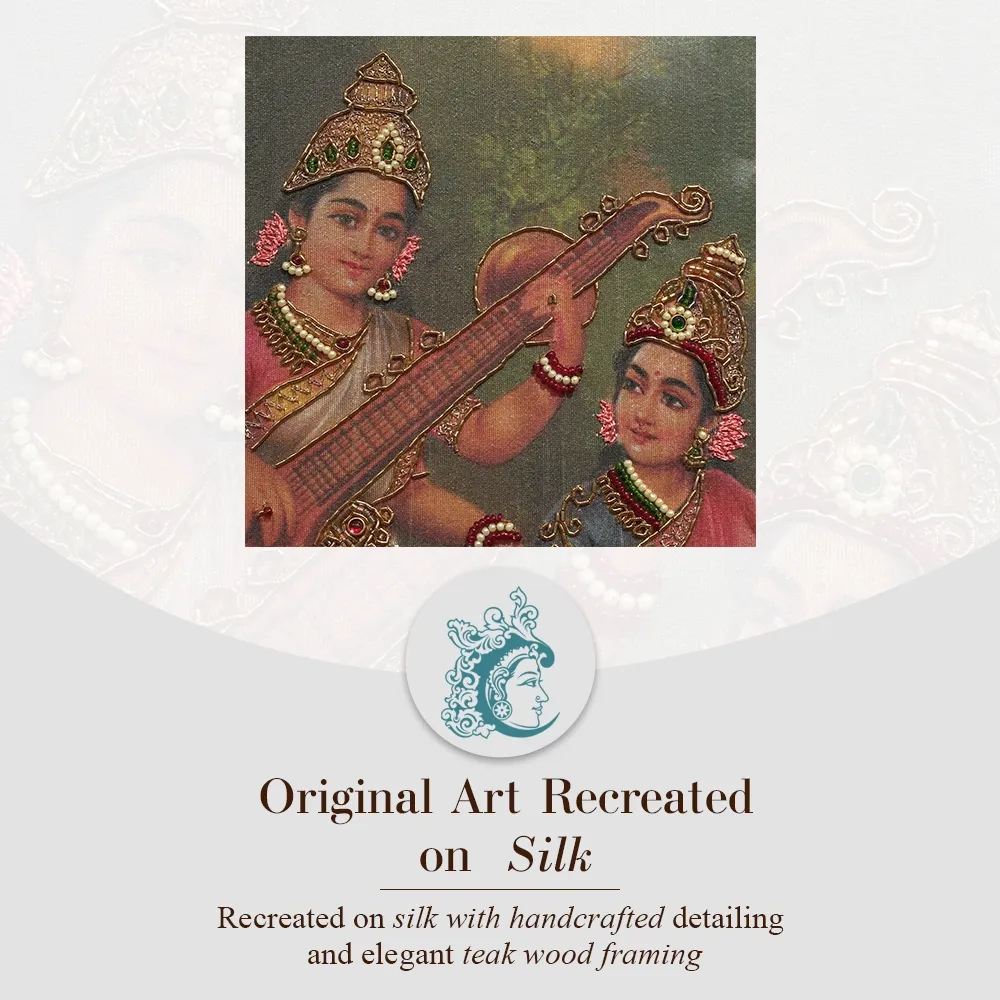
This art form is especially known for its treatment of the face. The eyes, expression, posture, and ornamentation were carefully composed to create familiarity and reverence. The divine was shown with dignity, but also with closeness. That is why these images became part of memory.
Sivakasi played a crucial role in spreading this tradition. Its printing presses helped transform original paintings into calendars, posters, and framed devotional prints. Some Sivakasi printing houses have histories going back to the early decades of the 20th century, and the region became strongly associated with large-scale calendar and print production.
Over time, the original paintings behind these printed images were often overlooked. The calendars remained, but the artist who created the original paintings faded from public memory. Chithiraalayam exists to correct that silence and bring to life these artists.
It preserves and presents the works of the masters who shaped this tradition. It recognises Popular Art not as ordinary calendar imagery, but as a serious visual culture that entered millions of homes and influenced devotional life across South India.
What was once printed in large numbers is now being looked at again with care.
Popular Art belongs to the people.
Chithiraalayam preserves its masters.
And through this work, a familiar tradition is given the dignity it always deserved.