About
Museum of Popular Art
CHITHIRAALAYAM is a museum and a gallery space of the Popular Art tradition which found its place of origin in Kovilpatti, Tamil Nadu and grew into a language of the visual, in which generations in South India came to imagine the divine.
The images were once an integral part of a popular devotional life that was lived. It was on calendars, print-sheets sold near temples and steps, framed images in homes and in the quiet nooks of pooja rooms. They were so familiar, so woven into memory that their history was unimportant. Gathering them together was in many ways an act of remembrance.
We wanted the collection to do more than just document the range of artists who worked within this tradition. It had to also speak to the distinct visual voices that animated and formed its aesthetic. There was one central figure in this movement, who was and continues to be seen as a singular force that animated the Popular Art style and was the creative lynchpin for generations of artists that came after him. C. Kondiahraju, his style, his oeuvre, forms the central archive of the collection at Chithiraalayam. Other renowned artists MU. Ramalingam, T.S. Subbiah and the images of several others whose work became part of the South Indian visual memory, are also on display at the museum.
In their paintings, the processional presence of the temple was translated into forms that could find their place into homes, and become portable, familiar and intimate.
Chithiraalayam too was an idea that was born from within this artistic genealogy.
The first idea to set up the gallery was Ms. Jayabharathi, daughter in law of MU. Ramalingam, and wife of K.R. Somasundaram. The idea was to house together and preserve works by Ramalingam, and by extension, the larger tradition of Kovilpatti Popular Art.
Somasundaram went on to follow the legacy of his father. He became a prolific calendar artist in his own right, whose works were in high demand at the printing presses of Sivakasi. But parallel to the work that he did through his own artistic practice was a deep desire to preserve the past and build a legacy, one that was built not just for his father’s works but for the larger fraternity of Kovilpatti artists who had been influenced by the legendary artist and teacher C. Kondiahraju, and the culture of painting, learning and creating that was so effectively channelled and passed on by him to his generations of students through his discipline and sense of devotion to the arts.
The idea found supporters within the family.
The children of Ramalingam, were brought on board by Jayabharathi, to work together in an effort to archive, preserve and carry forward the legacy of this devotional imagery that shaped a large part of South India for many generations.
Over the decades, many of the original paintings of this tradition had found their way into private collections, storerooms, in some cases obscurity. The search for these, their identification and eventual acquisition once again was a process that spanned years and multiple sources of information.
What is on display at Chithiraalayam today is therefore less a collection and more an archive that is still being built and recreated.
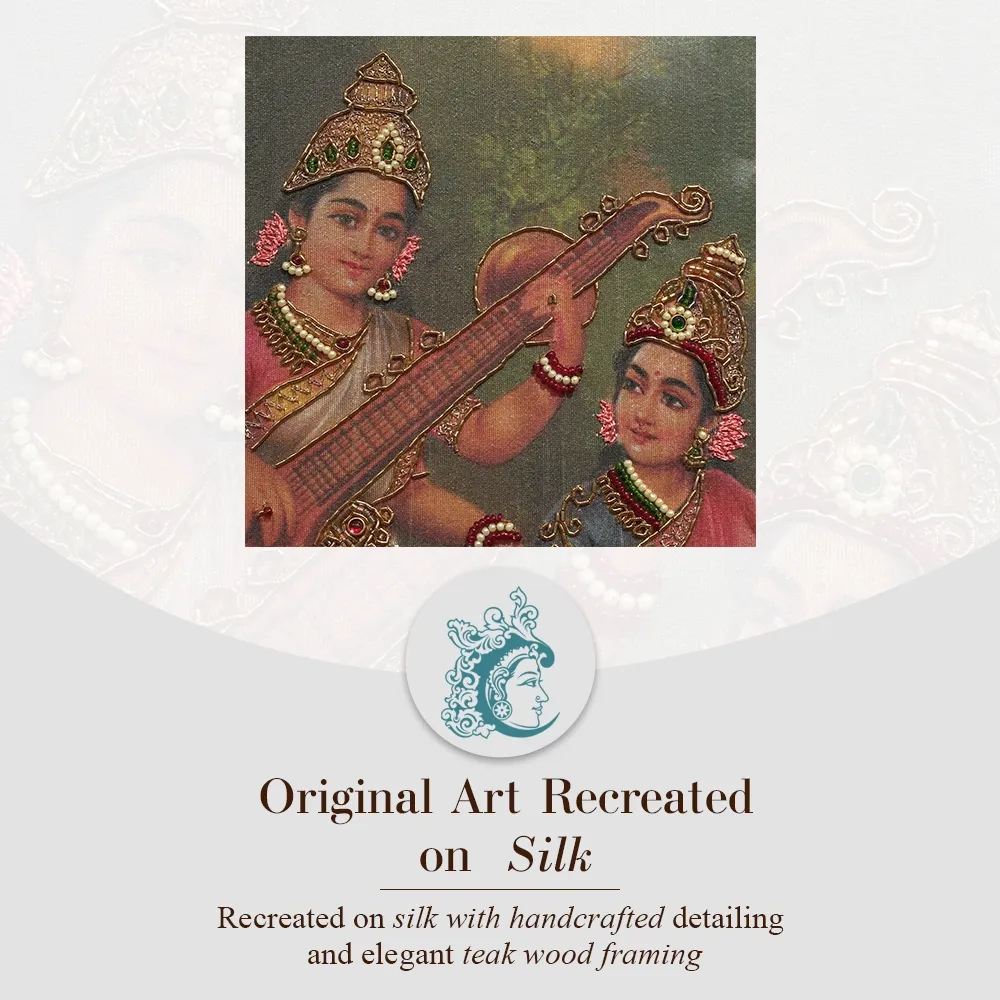
The works that are on display here, are recreated onto silk, with minute details worked out by hand, and are framed onto teakwood boards. It is an effort at preservation, rather than an attempt at substitution of the original artwork. It seeks to carefully extend the life of the image into contemporary spaces while maintaining the sanctity of the culture and devotional sensibilities the images themselves were part of.
They are not just images that we frame, they are forms that have been lived with, images that have occupied homes and stayed with through rituals and have been passed through generations in memory.
At Chithiraalayam, we make them available once again, not as an act of nostalgia but as images to be preserved, to live with and to pass on.
A Note Of Gratitude
Chithiraalayam is the work of a collective, of many minds, hands and people and is not the effort of a single individual, nor the work of a family alone.
It is instead the sum total of trust, generosity and contribution from many people who have been part of this tradition.
The effort of identifying, locating and preserving these would not have been possible without the support, guidance and interest of many people, families, printers and well-wishers, who have been instrumental in helping realise the importance of Popular Art and of preserving it as a living legacy.
We would like to thank:
Paintings Acquired from
Orient Litho Works, Sivakasi
Orient Color Crafts, Sivakasi
Coronation Art Craft, Sivakasi
Das Printers, Sivakasi
Raghul Rajora
Art Allied Materials Donors
S.Meenakshisundaram Family
M C Jaganathan Family
Parani Chittar Family
Sivan
Mahadevan
Well-Wishers
Daniel Smith, Former professor of Hinduism and Asian Religions, Syracuse University, Chronicler of Indian Art
Stephen R. Inglis, Professor Carleton University Canada, Researcher, Author, Expert on Art forms.
Dakshina Chitra, Chennai. Indian Heritage Museum and Exhibitors of Indian Art.
Swarnavel, Film Historian and Writer
Gandhi Balasubramanian, Art Critic
Rengaiah Murugan, Author and Historian of Kovilpatti style of Art
Vaishnavi
S.Marieswaran
Families
S.S. Rajoo
Venkatasubbiah
T.S. Arunachalam Family
K.G. Gnanaguru
Kuppamal Family (Cousin sister of C Kondiah Raju)
Murugabopathy
Papaiah Family
Assisted in acquisition of the original paintings
Karthigai Selvan
Pachiappan
P K M Ganesan
Purushothaman