What Stephen R. Inglis saw in South India’s Popular Art tradition
There are art forms that belong to museums. And then there are art forms that belong to people.
For decades across South India, devotional images of gods and goddesses occupied walls, pooja rooms, tea shops, textile stores, buses, and calendars. They were everywhere, so familiar that they almost disappeared into everyday life.
To most people, they were simply “calendar pictures”.
To Canadian scholar Stephen R. Inglis, however, they represented something far more significant: one of the most influential visual traditions in modern Indian culture.
Looking beyond “calendar art”
In his influential essay Suitable for Framing: The Work of a Modern Master, Inglis examined how printed devotional imagery transformed the relationship between art and everyday life in India.
What interested him was not only the artwork itself, but its extraordinary presence across society.
As an anthropologist studying communities in Tamil Nadu, Inglis noticed that these images existed everywhere, in homes, shops, schools, temples, and workplaces. Unlike classical paintings confined to elite spaces, Popular Art had become deeply woven into ordinary life.
The images were affordable, portable, emotionally direct, and culturally immediate. They did not wait to be discovered in galleries. They arrived directly into people’s homes.
The Kovilpatti connection
Inglis traced one of the strongest movements of this art tradition to Kovilpatti, a town in southern Tamil Nadu that became a major centre for devotional imagery in the mid-20th century.
At the centre of this movement stood C. Kondiah Raju, an artist whom Inglis regarded as one of the most influential figures in South Indian Popular Art after Raja Ravi Varma.
Kondiah Raju began his career painting elaborate stage backdrops for travelling drama companies before establishing studios in Kovilpatti. These studios later became training grounds for an entire generation of artists.
Among his students were artists such as:
- T. S. Subbiah
- Mu. Ramalingam
- S. Meenakshisundaram
- T. S. Arunachalam
Together, they would shape the visual language of Popular Art for decades.
The divine made familiar
One of Inglis’ most important observations was that Popular Art changed how people visualised divinity.
These images simplified forms without losing sacredness. The compositions were bold, expressive, colourful, and emotionally immediate. Gods were no longer distant temple icons alone, they became familiar presences within the household.
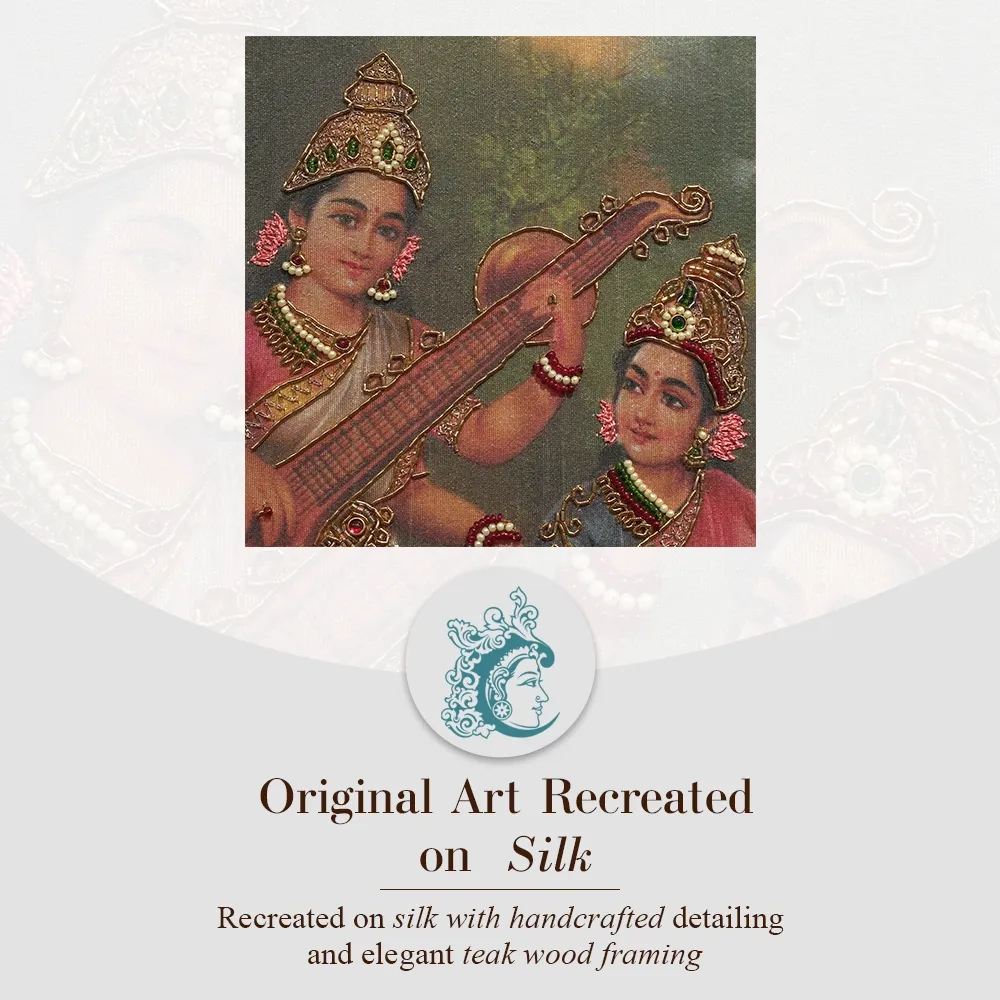
A Murugan with decorative backdrops. A Lakshmi glowing in vibrant colour. A Saraswathi beside a child’s study table.
These images entered domestic life so completely that they became part of memory itself. Inglis noted that the “recognition factor” of deities increased dramatically through printed imagery. People across regions began identifying gods through these standardised visual forms.
Sivakasi and the rise of mass devotional imagery
The growth of printing presses in nearby Sivakasi transformed the scale of distribution.
According to Inglis, presses such as Orient, National, and Coronation helped produce devotional prints in enormous quantities.
Artists like Mu. Ramalingam created hundreds of compositions over their lifetime, many reproduced in lakhs and circulated across India and abroad.
Inglis saw this not as the decline of art, but as a new form of cultural communication.
The printed image became:
- devotional object
- household presence
- ritual companion
- cultural identity
All at once.
Beyond commerce
Perhaps Inglis’ most striking insight was this: Even though these images were commercially printed and widely distributed, people did not treat them as disposable objects.
- They were framed carefully.
- Garlanded.
- Placed in prayer spaces.
- Protected.
Over time, the image acquired sacred meaning through use. The value of the artwork did not come from rarity alone, but from emotional and spiritual intimacy.
Why this matters today
As digital printing and changing lifestyles replaced traditional calendar culture, many original paintings disappeared. The artists behind them were rarely documented in mainstream art history.
Yet Inglis believed this tradition deserved serious attention.
He argued that Popular Art expanded the sacred role of images in modern India and created a shared visual language that crossed class and geography. Today, institutions such as Chithiraalayam in Chennai are attempting to preserve this legacy by collecting original works and presenting the history behind them.
In many ways, this effort echoes Inglis’ own belief: that understanding the artists and their work is essential to preserving the tradition itself.
A tradition hiding in plain sight
Popular Art was never rare. That was precisely its power.
It belonged to millions of people, entered ordinary homes, and quietly shaped the visual imagination of modern India.
Stephen R. Inglis recognised this long before many others did.
And today, as these images return to galleries and archives, they are finally being seen not merely as calendars, but as one of South India’s most important cultural movements.